Robotics & Autonomous Systems Laboratory
Research
From mathematical guarantees to robotic motion
Understanding motion.
Enabling autonomy.
How does a robot know where it is, move safely, and coordinate with others?
At LaRSA, these questions connect control theory with simulations and experiments. We develop estimation and feedback methods for robots operating with limited sensing and uncertain environments.
See the demonstrations ↗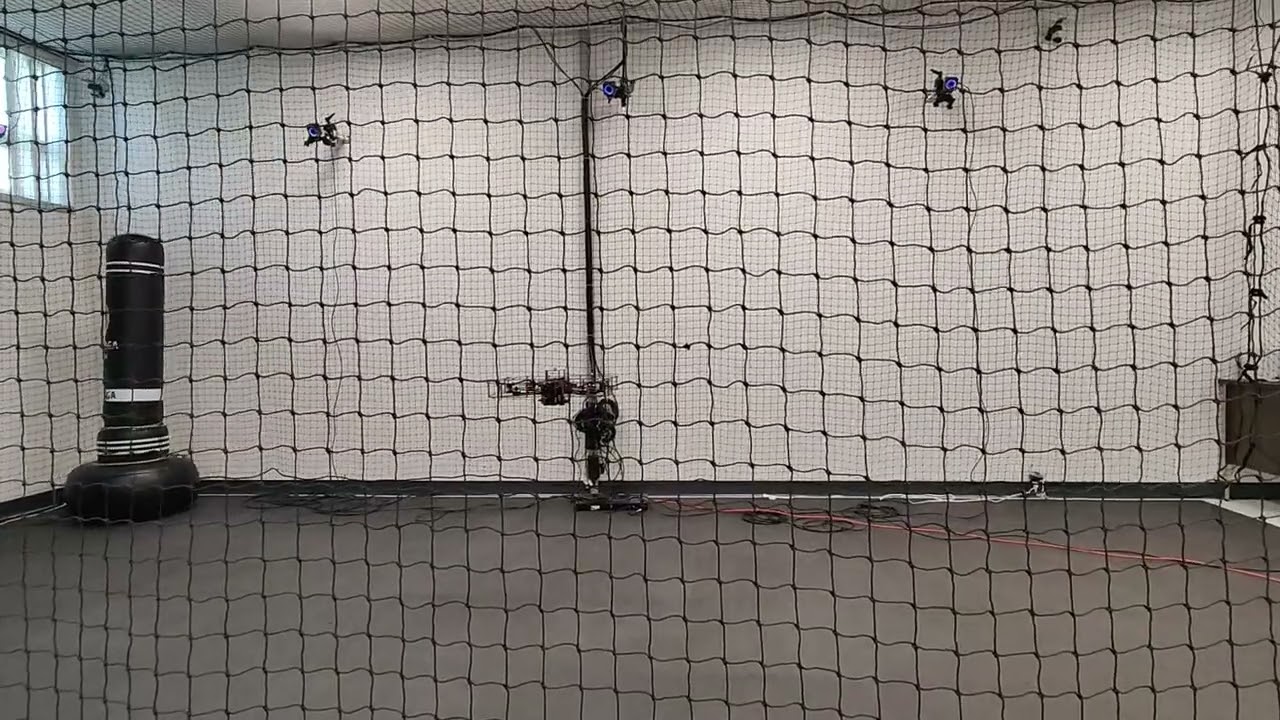 Inside LaRSA Watch on YouTube ↗
01 / State estimation & navigation
Knowing where you are—with less to go on.
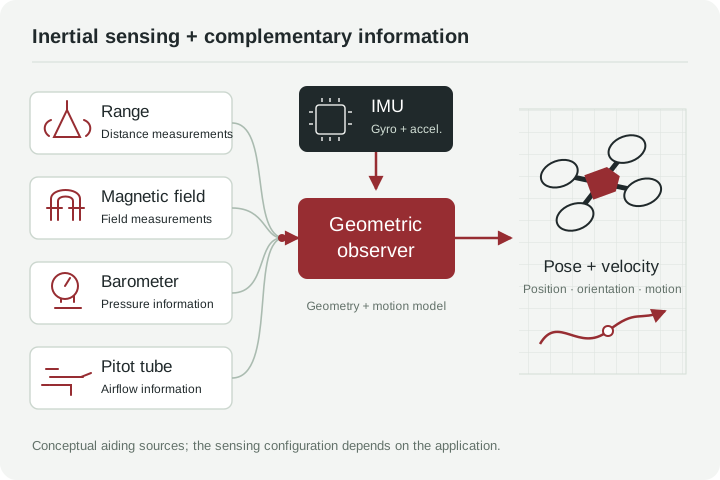
A robot measures its surroundings and its own motion, but it cannot directly measure every part of its state. We study how to recover position, orientation, and velocity from the information available.
Our geometric observers combine inertial sensing with aids such as cameras, range, magnetic fields, barometers, and Pitot tubes. Observability analysis identifies when those measurements contain enough information.
- Aided inertial navigation: a modern treatmentIEEE Control Systems Magazine · Accepted
- Navigation aided by a single range measurementIFAC World Congress · 2026
02 / Safe autonomous motion
Avoid the obstacle.
Keep the destination.
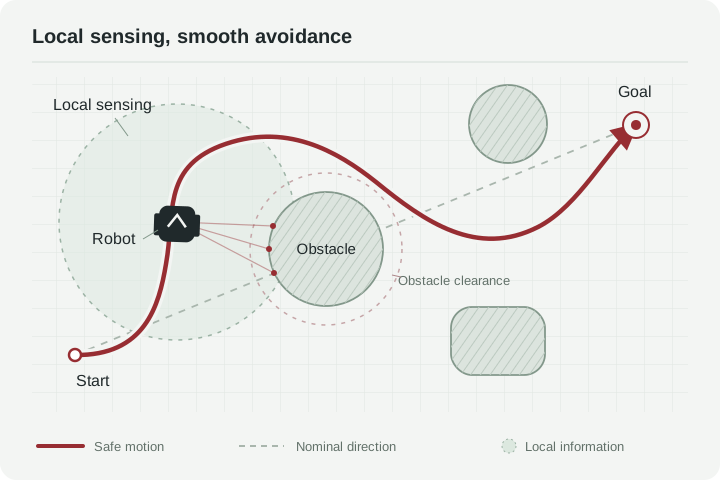
Collision avoidance is only part of the problem. A robot should also continue toward its goal, using the environment information it can actually sense.
We develop reactive navigation laws and safety filters that account for sensing limits and vehicle dynamics. Velocity cones, smooth penalty feedback, and dissipative methods connect obstacle avoidance with convergence analysis.
- Smooth feedback with convergence guaranteesAutomatica · 2026
- Sensor-based control in unknown environmentsAmerican Control Conference · 2024
03 / Cooperative robotics
Many robots.
A shared space.
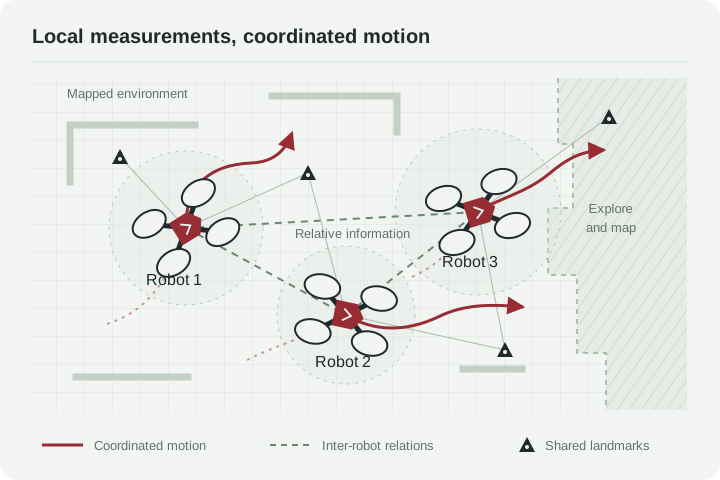
As robots work together, each must respond to both the environment and its neighbours. We investigate how local information can support coordination across a team.
Our work covers attitude synchronization, bearing-based leader–follower formations, cooperative estimation, localization and mapping, and multi-agent collision avoidance.
- Global attitude synchronization on SO(3)IEEE Transactions on Automatic Control · 2026
- Leader–follower bearing formation controlIEEE CDC · Accepted
04 / Nonlinear & hybrid control
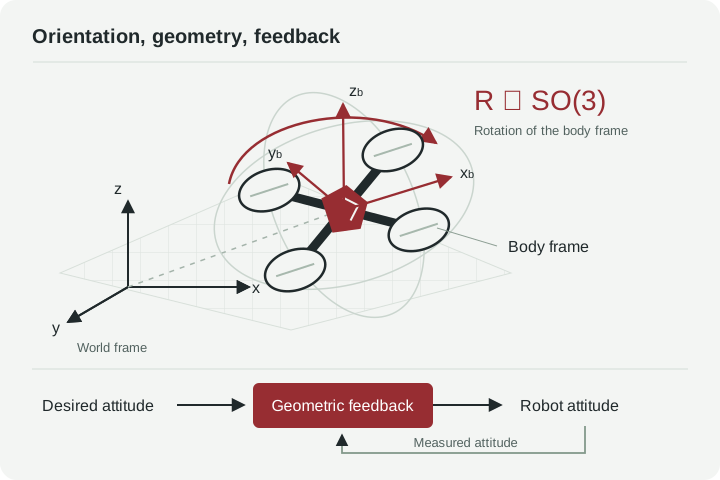
Control that respects the geometry.
A robot's orientation is more than three independent angles. Designing directly on rotation groups allows us to work with the underlying geometry of its motion.
We study geometric feedback and observer design, and hybrid methods that combine continuous dynamics with discrete decisions. Stability and convergence analysis guide how these methods are constructed.
- Hybrid attitude stabilization on SO(3)Published research
- Hybrid feedback for global navigationIEEE Transactions on Control Systems Technology · 2026
Explore the work
From an idea to a moving robot.
Watch experiments and simulations, read the technical results, or meet the people behind them.